Copyright-Safe AI Songwriting: How Hit Station Protects Your Catalog in Any Language
AI has made it possible to generate songs in seconds, but it has also made rights and ownership more confusing than ever. In many countries, including the United States, works created entirely by AI with no meaningful human input generally are not eligible for copyright protection.
For serious writers, publishers, and catalog owners, that is a problem. A song that cannot be protected is a song that is hard to monetize, license, or build a long-term business around. Hit Station was designed for the opposite use case: human-led, AI-assisted songwriting with clear authorship and an auditable trail, so catalogs stay both creative and legally defensible.
Why fully AI-generated songs are risky for catalogs
Recent guidance from copyright offices and courts has been explicit: music generated entirely by AI, where the machine determines melody, rhythm, and lyrics with minimal human involvement, generally cannot be registered for copyright. Merely typing a prompt into a tool is not enough to qualify as human authorship.
That does not mean AI music is illegal or unusable. It means that without substantial human contribution, the result is closer to public-domain material than a protected asset. For catalog owners, that raises questions about long-term value, exclusivity, and control. If anyone can replicate or republish similar outputs, the leverage of owning the “master” or “composition” becomes weaker.
The opportunity: AI-assisted, human-authored songs
At the same time, many legal and industry frameworks recognize that human-authored expression can still be protected when AI is used as a tool rather than a replacement. If a songwriter or team meaningfully shapes structure, lyrics, arrangement, editing, and performance, those contributions can qualify as copyrightable creative input even if AI helped along the way.
This is where structured AI songwriting becomes powerful. When AI is used to brainstorm ideas, suggest variations, or generate drafts that are then transformed by humans, the resulting song can be both efficient to create and legally protectable. Hit Station’s architecture is built to support that pattern by keeping humans in control and recording how the song evolves over time.
How Hit Station keeps authorship visible
Hit Station treats AI as a collaborator inside a professional writing environment, not as a one-click song factory. From the moment a song is created, the platform timestamps the work, stores versions, and keeps track of who is editing what.
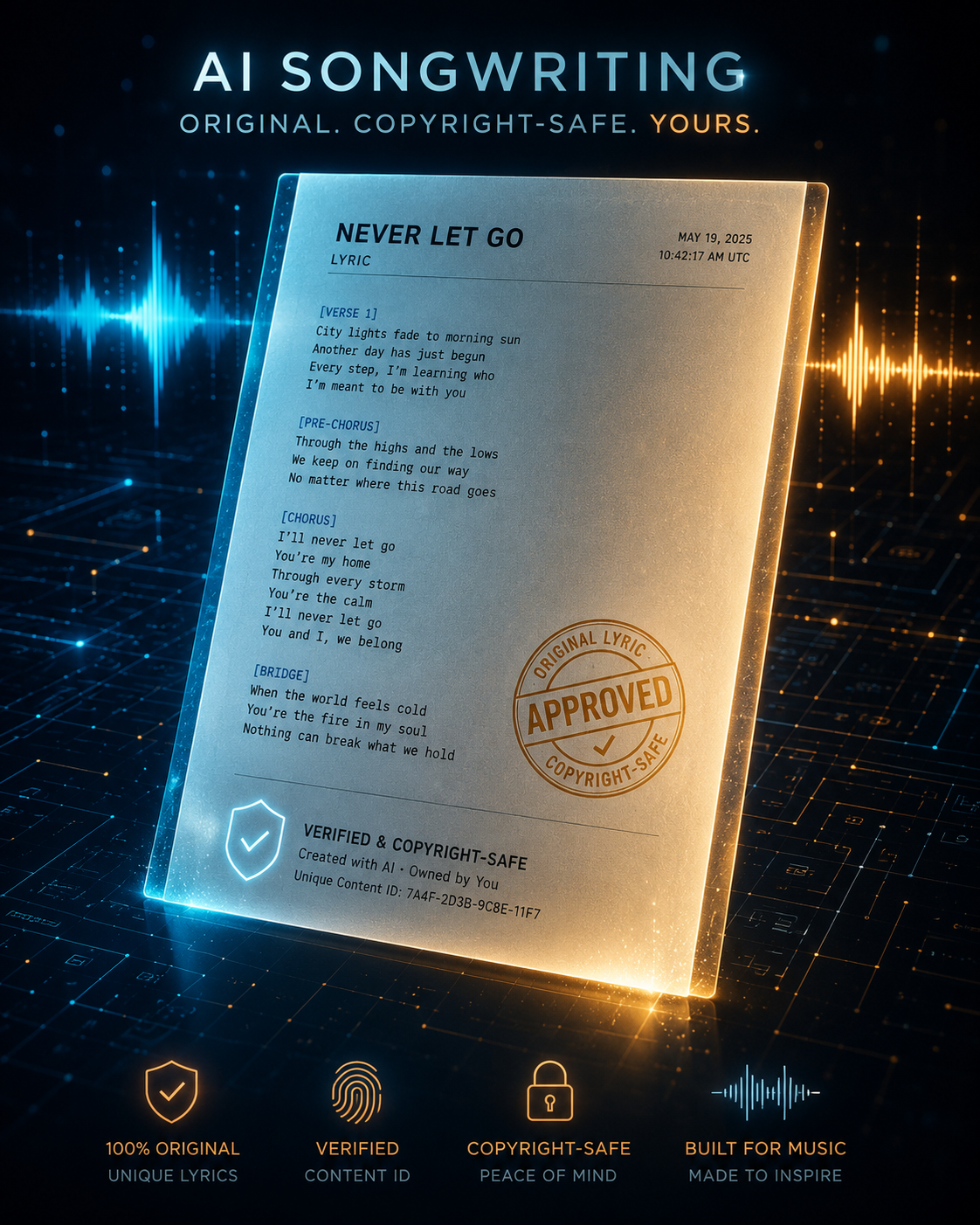
Each song can be exported as a timestamped PDF that includes lyrics, creation date, version number, author name, and a unique document identifier. This kind of “paper trail” acts as evidence that a human writer guided and refined the work, which matters when registering songs, proving priority in disputes, or negotiating catalog deals. Combined with version history and Hit Scores, it also shows how a song moved from draft to finished form in a way that pure AI demos cannot.
Structuring human contribution into the workflow
A big part of copyright safety is not just documenting what happened but structuring the process so human creativity is essential at every stage. Hit Station encourages this by building human decisions into the core workflow.
- Writers choose genre and sub-genre, emotional drivers, target structure, and hook strategy before any lyric is drafted.
- The system generates sections using The Hit Maker methodology, but writers edit, rewrite, and create Alt Takes that reflect their taste and artistic intent.
- Section-by-section regeneration and feedback-driven missions nudge writers to make deliberate changes tied to hook strength, emotional resonance, and structure, rather than accepting the first output.
This means the final lyric is not just a model’s snapshot; it is a cumulative human-led composition that can be tied back to specific creative choices.
Managing multilingual catalogs without losing control
Global catalogs increasingly need songs in multiple languages, but straightforward translation can introduce rights and quality issues. Hit Station addresses this by supporting eight languages – including English, Spanish, French, German, Portuguese, Japanese, Korean, and Mandarin – with full methodology and scoring applied natively.
Because hooks, rhyme, and cadence are engineered directly in the target language, writers can craft versions that feel like first-class songs instead of afterthoughts. Version tracking and timestamped exports make it clear which writer contributed to which language adaptation, which is crucial when assigning splits or registering separate local variants of a song.
Governance for teams, co-writes, and publishers
When multiple people work on AI-assisted songs, clarity around roles and contributions becomes even more important. Hit Station’s collaboration features help teams keep that governance organized.
- Shared songs and secure links keep co-writes inside one environment, instead of scattered across email threads and messaging apps.
- Feedback threads attach comments directly to specific sections, so notes and changes are easy to trace.
- A library and analytics dashboard show the catalog as a whole, including genre distribution, Hit Score trends, and top-performing songs.
For publishers and catalog managers, this makes it easier to implement internal policies such as “AI must be disclosed,” “authors must record which tools were used,” or “minimum human edit thresholds before a song is pitched.”
Building a “safe release file” for AI-assisted songs
Distributors and labels are already asking artists to prove they have the rights to AI-assisted recordings. Simple documentation goes a long way. A practical “safe release file” often includes:
- Confirmation that the AI tools used grant commercial output rights.
- Notes on which parts of the song were human-written vs AI-assisted.
- Evidence of lyric authorship and timestamps.
- Split agreements and collaborator approvals.
Hit Station gives writers a head start by providing timestamped lyric PDFs, version history, and Suno-ready exports that clearly encode structure and authorship. When combined with external documentation (such as AI tool licenses, vocal model agreements, and production stems), this makes it much easier to show that the final release is a human-led work built on licensed tools.
Reducing legal and ethical risk without killing creativity
The goal of copyright-safe AI songwriting is not to smother experimentation. It is to make sure creative risk does not turn into avoidable legal risk. Clear governance also helps protect artists whose voices or likenesses might otherwise be imitated without consent.
By keeping the songwriter at the center, recording human decisions, and encouraging structured, hook-first writing, Hit Station offers a path where innovation and catalog safety can coexist. Writers get the speed and idea generation that AI makes possible, while publishers and partners get the attribution, documentation, and structure they need to sign deals with confidence.
Practical steps for copyright-safe use of Hit Station
For writers and catalog owners who want to stay on the right side of evolving rules, a few habits go a long way.
- Always declare AI involvement and keep notes on tools and prompts used. Documenting this in your song’s metadata and lyric exports makes later registration or audits much easier.
- Ensure every song passes a “human contribution” test. Ask whether a human meaningfully shaped the lyric, structure, arrangement, and emotional arc, not just the prompt.
- Use Hit Station’s version history as evidence. Save drafts and use timestamped PDFs to show progression from raw idea to finished lyric.
- Set internal rules for teams. Decide in advance how much AI assistance is acceptable, how contributions are credited, and how splits are assigned.
- Work with partners who value attribution. Focus on platforms and tools that are transparent about training data, output rights, and future licensing models.
Taken together, these practices help ensure that AI-assisted songs become durable catalog assets instead of fragile experiments.
Catalogs built to last, not just to trend
AI has shortened the gap between idea and execution, but long-term value in music still comes from works that can be owned, licensed, and trusted. Hit Station’s human-led, documentation-first approach helps writers and publishers build those kinds of works in every language they care about.
When every song session leaves behind a clear record of who did what, catalog conversations move away from fear and toward opportunity. Instead of asking “Is this even legal to release?”, teams can ask better questions like “Where does this song belong?” and “How do we scale this methodology across our roster?”