From AI Idea to Radio-Ready Song: A Producer’s Workflow with Hit Station
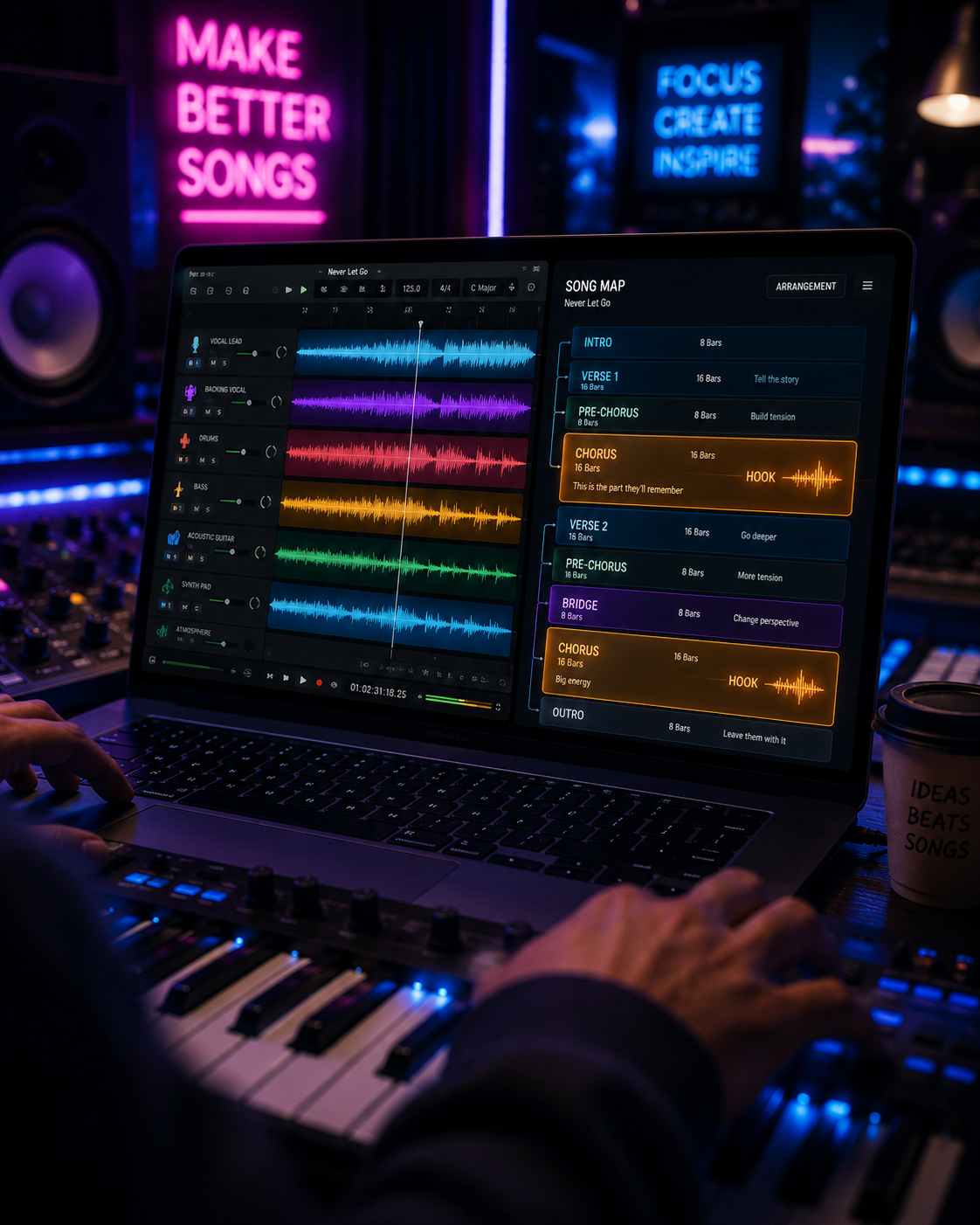
Text-to-music tools can now turn a prompt into a full track in seconds, complete with vocals, drums, and a rough structure. For producers, that is both exciting and frustrating: the ideas arrive fast, but the songs often are not structured, hook-driven, or lyric-ready enough to ship.
The solution is not to abandon AI, but to put it in the right place in the workflow. AI engines can handle rapid ideation and texture, while Hit Station handles song architecture, hook and lyric craft, and documentation, and your DAW handles final production and polish. This article walks through a practical, repeatable flow from AI sketch to radio-ready song.
Why producers need a structured AI workflow
Studies and surveys show that most producers already use AI for ideas, stems, and processing rather than full songs. Typical workflows involve generating batches of ideas in text-to-music tools, exporting stems, and then moving into a traditional DAW for arrangement and mixing.
The missing piece in many of these workflows is a dedicated “songwriting layer” between raw AI audio and the final session. Without that layer, songs inherit whatever structure the model guessed, and lyrics are often generic or mismatched to the artist. Hit Station fills that gap by giving producers and writers a place to design the hook, sections, and lyric before committing to a final arrangement.
Step 1: Generate and select AI ideas
Start with your preferred text-to-music tool – for many producers that is Suno, Udio, or similar platforms. Use strong prompts that specify genre, mood, tempo, vocal identity, and use case, and generate multiple short ideas rather than one long track.
Listen for three things:
- Does the core groove or progression feel like it has room for a strong hook?
- Does the vocal delivery or top-line suggest a particular emotional lane?
- Can you imagine a real artist or project using this as a foundation?
Pick one or two ideas that pass this test and export them as reference audio or stems for later. At this stage, the goal is not perfection; it is to capture energy and direction.
Step 2: Translate the idea into a song brief
Before diving into lyrics or detailed arrangement, turn that AI idea into a clear song brief. This is where Hit Station enters the picture.
Inside Hit Station, start a new song and configure:
- Genre + sub-genre to match or refine the AI output’s lane.
- Emotional drivers (for example Desire + Defiance, Loss + Triumph) based on what the track feels like.
- Target structure – Viral Hook, Radio Single, Streaming, or Full Arrangement – depending on whether this is aimed at social, playlist, or radio.
- Hook type (melodic, lyrical, rhythmic, conceptual, or sonic) based on what stands out in the AI audio.
This converts a vague “cool idea” into a concrete, hook-first plan that Hit Station can write against.
Step 3: Build a hook-first lyric in Hit Station
With the brief locked, use Hit Station’s guided workflow to generate a first-pass lyric built around your chosen hook strategy. The system drafts the chorus first, then shapes verses, pre-choruses, and bridges to support that payoff.
At this stage:
- Focus on landing a chorus that feels immediately singable over the AI track’s main section.
- Use Alt Takes to explore multiple chorus options and pick the one with the strongest Hit Score for hook strength and emotional resonance.
- Keep the verses and bridge flexible; you can refine details once the chorus is locked.
The aim is to come out with a chorus title, hook phrase, and section layout that can map directly onto the AI idea’s structure or a slightly refined version of it.
Step 4: Align structure and sections
Next, map Hit Station’s structure to the AI audio. Many AI tracks have loose or unexpected section lengths, especially when extended. Decide whether to:
- Edit the AI audio (for example, cutting or looping sections) to fit the Hit Station structure, or
- Adjust the Hit Station structure to match a particularly strong AI performance.
Hit Station’s split-pane editor and word budgets per section make it easy to trim or extend lyrics to fit repeats, drops, and build-ups. If a verse feels too long for the audio, reduce lines. If the chorus needs an extra repetition, adjust the lyric accordingly. The goal is to have a lyric map that lines up cleanly with the reference track so recording or AI re-generation becomes straightforward.
Step 5: Refine with Hit Score and Alt Takes
Once structure lines up, use Hit Station’s Hit Score system to refine the song.
- Check Hook Strength: does the chorus repeat the key phrase enough, land in the right place, and contrast with the verses?
- Check Emotional Resonance: do verses actually support the chosen emotional drivers, or drift into generic lines?
- Check Structural Efficiency: are any sections bloated or underdeveloped given your target format?
Use Alt Takes and section regeneration to address the weakest dimensions one by one. For example, rewrite a verse to raise Emotional Resonance without touching a chorus that already works, or tighten a bridge that currently restates the chorus instead of earning the final payoff. This is where you turn an AI-inspired song into something that feels handcrafted.
Step 6: Export a production-ready lyric and prompt
When the lyric and structure feel strong, export from Hit Station.
- Use the Suno-ready export to include section labels (Verse, Chorus, Bridge), tempo notes, dynamics cues, and vocal style tags.[^2]
- Save a timestamped PDF for rights documentation and to share with collaborators, vocalists, or publishers.
If you plan to regenerate the music around this lyric, you can plug the exported structure and sections directly into your AI tool’s prompt system, so the next audio generation respects the song form you just engineered.
Step 7: Finish in your DAW
From here, move into your DAW as usual.
- If you are using AI audio as the base, import stems or the full track and align the vocal recording (human or AI) with the Hit Station lyric.
- If you regenerated audio around the Hit Station export, treat it as you would any demo: replace parts, re-record vocals, add or strip layers, and mix.
- Use your usual tools for EQ, compression, effects, and mastering to bring the track up to release standard.
The difference is that you are not fighting the song’s form while mixing. The structure, hook, and lyric have already been engineered and validated, which makes production choices clearer and faster.
Example workflow: from Suno sketch to streaming-ready single
To make this concrete, imagine a producer working on a modern R&B-pop crossover track:
- Generate five 45-second Suno ideas based on a detailed prompt specifying genre, mood, BPM, and intended use.
- Choose the strongest idea and export the audio.
- In Hit Station, set genre to R&B / Pop, emotional drivers to Desire + Nostalgia, and hook type to lyrical.
- Use the guided wizard to generate a first-pass chorus and verses, then refine with Alt Takes until the Hit Score shows strong hook and structure metrics.
- Align the lyric with the AI audio by trimming a verse and repeating the chorus to match the track’s build.
- Export Suno-ready lyrics and regenerate a longer, better-structured version of the track that follows the Hit Station sections.
- Bring the extended stems into a DAW, replace the AI vocal with the artist’s performance, and mix as usual.
The end result is not a “random AI song.” It is a producer-driven record that used AI for ideation and raw materials, Hit Station for songcraft, and traditional tools for performance and polish.
Responsible integration: AI as assistant, not replacement
Responsible AI integration in music is about using machines to handle repetitive or exploratory tasks while humans retain creative and ethical control. In this workflow, AI never decides what the song is about. It does not own the hook, define the emotional arc, or control who gets credit. Those decisions live with the producer, writer, and artist.
Hit Station is the glue that holds that balance. It gives producers a place to make intentional songwriting choices, document authorship, and improve their own craft while still taking full advantage of AI’s speed and range. That is how AI ideas become radio-ready songs rather than disposable curiosities.