Human-Led AI Songwriting: How Hit Station Turns Machine Ideas Into Real Hits
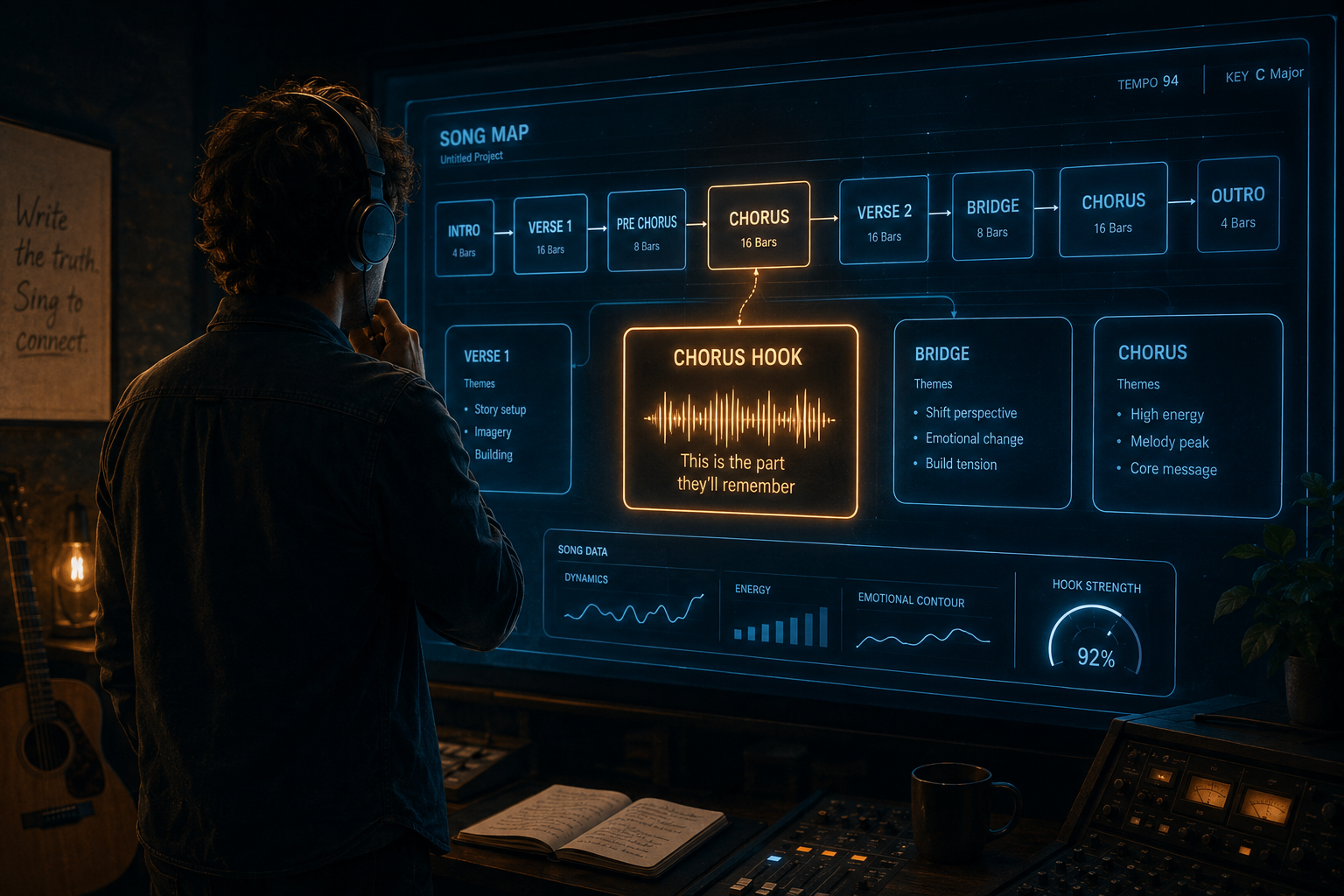
AI is already writing songs, but most of what it creates never makes it past the demo stage. If you care about hooks, emotion, and long‑term catalog value, the real opportunity is not “push‑button songs” – it is using AI as a disciplined co‑writer inside a craft‑driven process.
Hit Station was built for that middle ground. It is an AI‑powered lyric‑writing platform wrapped around a professional hit‑writing framework, so you stay the writer while the system helps you generate, refine, score, and protect chart‑worthy lyrics. In this article, we will show how human‑led AI songwriting works in practice and why it is the future for serious creators.
The new reality: AI is already in your writing room
Text‑to‑music and lyric tools have gone from curiosities to everyday utilities for working musicians. Platforms like Suno, Udio, and general AI assistants can now spin up melodies, chord ideas, or even full songs from a single prompt.
That shift has created a split in the creative community. Some artists worry that “AI songs” will replace human writers, while others quietly use AI for idea generation, warm‑ups, or breaking writer’s block. In practice, what is emerging is a spectrum: on one end, fully automated AI tracks; on the other, human‑written songs that use AI for specific tasks like brainstorming, editing, or translation. Hit Station sits firmly on the human‑led end of that spectrum.
Why hits still depend on human judgment
AI is excellent at patterns: it can mimic rhyme schemes, cadences, and genre conventions at scale. But hits are more than patterns – they are specific stories, lived experiences, and emotional arcs that connect to real people at a particular moment in culture.
Human writers decide what a song means. They choose which details to reveal, how much vulnerability to show, and how closely the lyric fits the artist’s real life or brand. They also decide what not to say, what to leave implied, and when to break the rules for impact – decisions today’s models cannot reliably make. AI can suggest a thousand lines; only a human can decide which one feels true and which one a crowd will actually sing back.
Full generators vs frameworks
Most AI music tools cluster at two extremes. On one side, full song generators promise “type a prompt, get a finished track,” but they hide the process and give you limited control over structure, hooks, and rights. On the other side, basic lyric generators spit out random verses or choruses with no methodology and no feedback loop.
Hit Station was designed to bridge that gap. Instead of being a black box, it exposes the steps professional writers actually use: defining genre and emotion, engineering hooks, structuring sections, and iterating with targeted feedback. The platform does not generate audio at all; it focuses on lyrics, arrangement guidance, and export formats that plug cleanly into your preferred production workflow.
AI as song coach, not song factory
At the heart of Hit Station is The Hit Maker methodology – a structured framework for engineering chart‑worthy lyrics. Every feature is there to help with one of the big levers that separate casual writing from professional work: hook strength, emotional resonance, structural efficiency, platform fit, and cultural timing.
Instead of tossing you into a blank page, Hit Station’s guided new‑song wizard walks you through four steps: Configure, Write, Refine, and Finish. You choose genre and sub‑genre (for example Dance‑Pop, Latin, or Neo‑Soul), pick core emotions, and describe the idea in your own words before a single line is drafted. That means the AI is aiming at a clear feeling and audience from the first bar, not improvising around a vague prompt.
A guided first draft that teaches the process
As the AI writes, Hit Station shows you real progress steps – analyzing genre conventions, drafting the chorus hook first, arranging verses, then scoring each section. This mirrors how professional writers actually work: define the concept, land the hook, then fill in verses and bridges around that spine.
You are never locked into what the system suggests. You can regenerate specific sections, import your own lyrics and have them auto‑parsed into sections, or skip the wizard altogether once you are comfortable. The goal is not to hand you a finished song; it is to give you a strong, structurally sound draft that invites revision instead of resisting it.
Hook‑first writing: engineering the moment people remember
In most hit songs, listeners can sing the chorus after one or two plays – that is not an accident. Hit Station makes hook design explicit by asking you to choose a hook type (melodic, lyrical, rhythmic, conceptual, or sonic) and then shaping the rest of the lyric around that choice.
The system weights hook strength heavily in its Hit Score, so you get direct feedback if your chorus does not repeat its key phrase enough, lacks contrast, or buries the title. Instead of vague advice like “make the chorus bigger,” you see exactly where hook execution is weak and can iterate with purpose. AI helps by proposing variations, but you choose which one feels like your song.
Emotional drivers: songs people actually feel
Listeners do not share songs because the rhyme scheme is clever; they share them because those songs made them feel something. Hit Station bakes that into the process by asking you to select emotional drivers such as Belonging, Desire, Loss, Triumph, Defiance, or Nostalgia – alone or in combinations like Desire + Loss.
With a named emotional target, the AI and the writer can check whether each section actually serves that feeling instead of drifting into generic storytelling. Over time, this trains you to think in emotional arcs rather than just topics – “breakup song” becomes “Loss with a thread of Triumph,” which changes how verses unfold and how the bridge resolves.
Structure as a competitive advantage
Streaming and social platforms reward songs that respect listener attention: they need to get to the hook fast, deliver repeatable moments, and avoid bloated sections that cause skips. Hit Station helps by offering four structure formats tuned to real‑world use – Viral Hook, Radio Single, Streaming, and Full Arrangement – each with word budgets and hook placement baked in.
Those constraints are not there to box you in; they are there to keep every line earning its place. If you choose a streaming‑optimized format, for example, the system keeps the total word count and section lengths aligned with typical playlist‑friendly runtimes, while leaving room for you to bend the rules in smart ways. Over time, you internalize what tight structure feels like without needing to count every line manually.
Multilingual hit writing without losing the hook
Most tools still treat English as the default and treat other languages as an afterthought. Hit Station takes a different approach: it supports eight languages – including English, Spanish, French, German, Portuguese, Japanese, Korean, and Mandarin – with the full methodology applied natively rather than via simple translation.
That means rhyme, cadence, and hook phrasing are engineered in the target language from the start, so your Spanish or Korean lyrics feel natural and playlist‑ready instead of like a literal translation of an English idea. For bilingual writers and teams targeting multiple markets, this makes it possible to keep a consistent emotional core while adapting hooks and imagery to each audience’s language and culture.
From draft to superior lyrics: the Hit Score loop
Once you have a working lyric, the next challenge is knowing what to fix. Hit Station’s Hit Score replaces that guesswork with a deterministic model that evaluates lyrics across five weighted dimensions: Hook Strength, Emotional Resonance, Structural Efficiency, Platform Compatibility, and Cultural Timing.
Each score comes with prioritized recommendations, like “your chorus repeats the main phrase only once” or “Verse 2 drifts from the core emotion,” so every edit session starts with a clear target. You can create alternate versions of any section (Alt Takes), compare their scores side by side, and keep the strongest without losing your original. The result is a safe laboratory for bigger swings – you are free to experiment, knowing you can always roll back.
A practical workflow: from AI idea to human‑led hit
Imagine a songwriter who starts with a rough verse from a general AI assistant or a melody idea from a text‑to‑music engine. They paste that concept into Hit Station, choose Pop / Dance‑Pop as the genre, select Desire + Triumph as emotional drivers, and pick a lyrical hook type anchored on a memorable phrase.
Hit Station drafts a first‑pass chorus and verses around that setup, then assigns a Hit Score and specific improvement missions. The writer uses Alt Takes to test three different choruses, keeps the one that scores highest on hook strength and emotional resonance, and trims a bloated second verse based on the structural efficiency feedback. Finally, they export a Suno‑ready lyric with section markers, tempo cues, and vocal notes, so the producer or AI music engine can bring the song to life without losing the architecture that makes it work.
Ethics, authorship, and copyright
As AI music becomes more common, questions about authorship and ethics are becoming central to industry debates. Regulators and collecting societies have signaled that works created entirely by AI may not qualify for the same protections as human‑authored compositions, especially when the human role is minimal or unclear.
Hit Station is designed to keep humans in the creative driver’s seat. The system encourages visible human choices at every stage – from emotional framing to line‑level edits – and captures version history with timestamps, authorship labels, and score snapshots. You can export timestamped PDFs that document when you wrote what, which is useful for rights registration, catalog management, and professional pitching.
Who human‑led AI songwriting is for
Human‑led AI songwriting is already helping:
- Emerging songwriters learn craft faster by seeing how structural, emotional, and hook decisions affect their scores.
- Professional lyricists work faster without surrendering voice or control, especially when juggling multiple projects or co‑writes.
- Producers and independent artists build streaming‑ready catalogs with lyrics that are singable and structurally tight, not just aesthetically pleasing on the page.
If you are serious about writing songs people remember – and you are open to smart tools that respect your authorship – human‑led AI is a practical way to combine speed with craft.
Try Hit Station on your next song
If you have been curious about AI but wary of “push‑button songs,” Hit Station is your on‑ramp to a different approach. Start with a single idea – a title, a line, or a mood – and let the system walk you through building a hook‑first, emotionally focused, structurally efficient lyric that you control from start to finish.
Your next song does not have to be a choice between a blank page and a black box. With Hit Station, AI assists and you create – one chorus, one hit hook, and one human story at a time.