Prompt Engineering for Hit Hooks: How to Talk to AI Music Tools Like a Pro
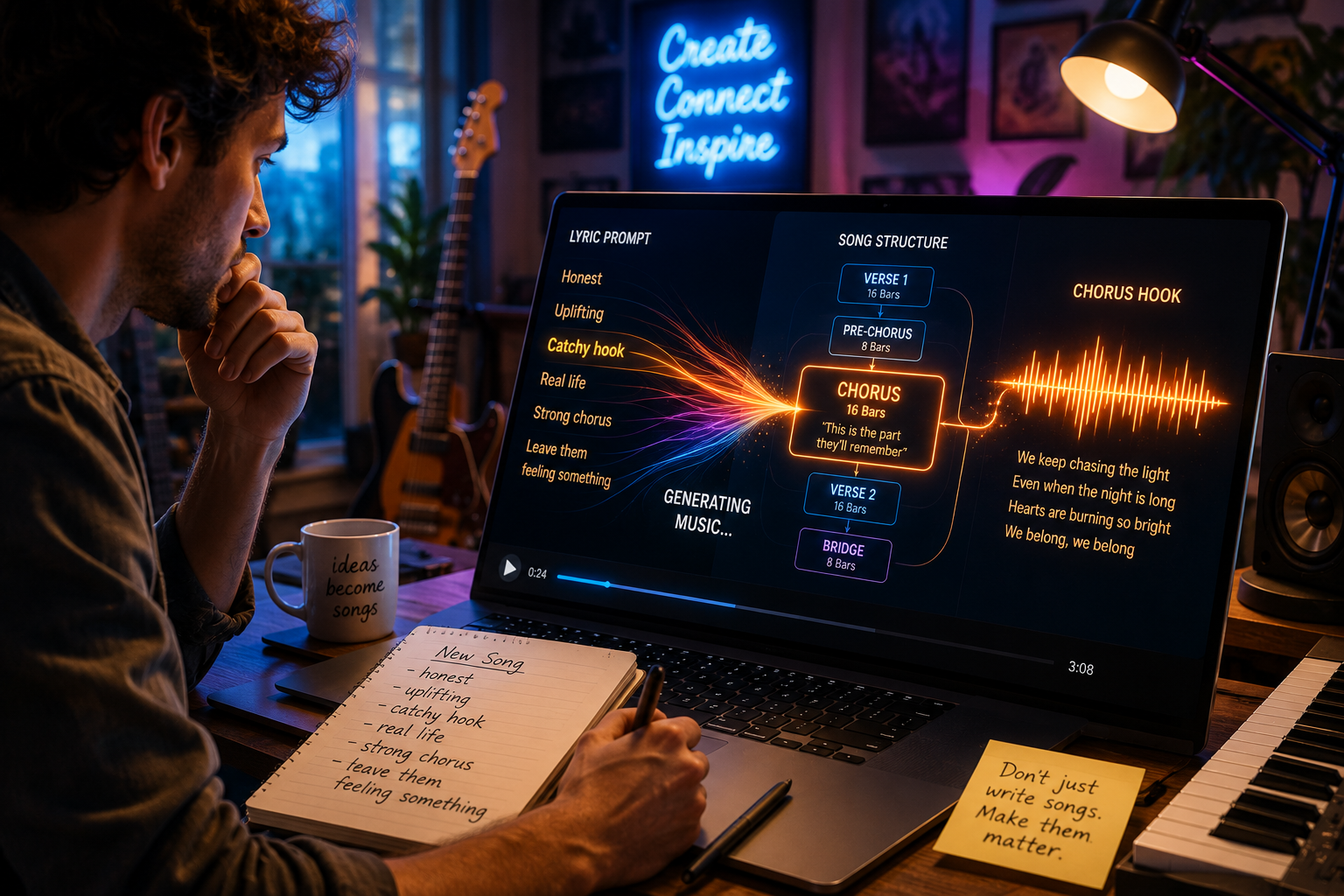
Most AI music outputs sound impressive for about ten seconds. Then the problems show up: the hook is weak, the sections blur together, the lyric says a lot without meaning much, and the whole thing feels more like a demo artifact than a real song.
That usually is not just a model problem. It is a prompt problem. In AI music generation, better prompts produce better raw material, and better raw material gives you a much better chance of writing a chorus people actually remember. Hit Station helps by turning prompt experimentation into a structured songwriting process, so you can move from vague AI output to a deliberate, hook‑first lyric workflow.
What prompt engineering means in music
Prompt engineering is the practice of writing clear, structured instructions so an AI system understands the result you actually want. In music, that means describing things like genre, mood, tempo, instrumentation, vocal style, section structure, and emotional arc instead of typing a loose sentence and hoping the machine reads your mind.
The difference is huge. A weak prompt like “write me a cool pop song” leaves almost every important decision unresolved. A stronger prompt gives the AI constraints: the style, the pace, the emotional target, the role of the chorus, and the type of hook the song needs to carry. Good prompt engineering does not remove creativity; it gives creativity direction.
Why generic prompts create generic songs
AI models are excellent at averaging patterns. If you feed them broad, lazy instructions, they tend to return broad, lazy results: familiar words, predictable melodies, safe emotional language, and chorus sections that do not earn repetition.
This is why so many AI songs sound interchangeable. When the prompt does not define the song’s emotional center, structure, and performance context, the system fills the gaps with defaults. You may get something “musical,” but not something memorable. For serious songwriters, that is not enough.
The five elements of a strong AI music prompt
The best prompts usually combine five core elements.
1. Genre and sub-genre
Start with the clearest musical lane possible. “Pop” is broad. “Dream pop,” “Latin pop,” “synth-pop,” or “Afro-pop with R&B influences” gives the system a more usable frame. Hit Station does this natively by letting you choose from major genres and sub-genres before the writing begins.
2. Mood and emotional target
Mood is not decoration. It tells the system what the song should make people feel. Words like nostalgic, defiant, euphoric, longing, intimate, or triumphant help shape the lyric language and pacing. Hit Station goes a step further by asking you to define emotional drivers such as Desire, Loss, Triumph, or Nostalgia so every section is anchored to a feeling rather than a topic.
3. Tempo and energy
Specific tempo information tends to improve consistency and usefulness. “Mid-tempo” is helpful, but “96 BPM with a steady, confident pulse” is better because it gives the system a physical sense of movement. Hit Station supports BPM and duration control so phrasing and word count align with how the lyric will actually be performed.
4. Instrumentation and vocal identity
Prompting works better when you describe who is performing the song and what sonic world it belongs to. Instead of “sad song,” say “female vocal, intimate delivery, sparse piano, warm pads, slow build into a wider chorus.” That kind of detail influences not only production tone but also lyrical diction and cadence.
5. Structure and hook intent
If you do not define the role of the chorus, the chorus often arrives undercooked. A strong prompt tells the system where the hook should live, whether it should repeat, what tension the pre-chorus should build, and what the bridge should achieve. Hit Station’s methodology handles this directly through hook type selection, structure formats, and section-aware writing logic.
The difference between a weak prompt and a useful prompt
Here is a weak prompt:
- “Write a catchy pop song about heartbreak.”
It gives the AI a genre and a topic, but almost nothing else. There is no emotional nuance, no pacing, no vocal context, no hook instruction, and no sense of audience.
Here is a stronger version:
- “Modern synth-pop ballad, 92 BPM, female vocal, intimate but resilient tone, theme of heartbreak after choosing self-respect, verse lyrics should feel confessional, pre-chorus should build emotional tension, chorus should repeat a short title phrase twice and feel instantly singable, sparse first verse with wider second chorus.”
The second prompt gives the model a musical frame, an emotional angle, a structural map, and a hook objective. That does not guarantee a hit, but it dramatically improves the quality of the first draft.
The best prompt formula for hook-first writing
For most creators, a simple reusable framework works best. A practical formula is:
- Genre + sub-genre
- Mood or emotional driver
- Tempo or energy
- Vocal identity
- Instrumentation or texture
- Section structure
- Hook instruction
- Story angle or theme
In plain language, that looks like this:
- “Latin pop with reggaeton influence, 100 BPM, male/female duet, flirtatious and nostalgic, nylon guitar and modern drums, clear verse/pre-chorus/chorus structure, chorus must repeat the title phrase, lyric should feel like a summer reunion that never fully ended.”
This is close to how professional writers brief collaborators in a room. They do not say “make something good.” They define the lane, the feeling, the lift, and the payoff.
How Hit Station improves prompt-based songwriting
Most AI tools stop after generation. Hit Station begins there. It takes the raw output from your prompt and places it inside a structured writing environment built around The Hit Maker methodology, where the goal is not just output but improvement.
First, Hit Station helps define the song before the lyric is written: genre, sub-genre, emotions, structure, hook type, BPM, and vocal setup. That alone solves one of the biggest problems in prompt engineering, which is that many creators start too vaguely.
Second, Hit Station evaluates what comes back. Its Hit Score measures hook strength, emotional resonance, structural efficiency, platform compatibility, and cultural timing, so you can see whether the prompt produced something usable or just interesting. Instead of guessing why the chorus feels flat, you get feedback tied to the actual craft dimensions that matter.
Third, Hit Station makes revision safe and systematic. You can create Alt Takes for a chorus or verse, compare versions, and keep the strongest one without losing your original draft. That aligns with one of the most consistent prompt engineering best practices: change one meaningful variable at a time, compare outputs, and refine from the best version instead of restarting blindly.
Prompt for songs, then prompt for sections
One of the best habits in AI songwriting is to stop treating the entire song as one giant command. It is often more effective to prompt at two levels: first for the overall song direction, then for individual sections like the chorus, verse, or bridge.
For example, you might begin with a broad creative brief for the whole song, then separately refine the chorus with a more specific instruction such as:
- “Rewrite the chorus so the title lands in the first line, the hook repeats twice, and the emotional tone shifts from longing to resolve.”
That kind of section-level prompt is where Hit Station becomes especially valuable, because the platform already treats the song as a collection of strategic parts rather than one text block. You can regenerate a weak section without throwing away what already works.
Three common prompt mistakes
Prompt engineering is not about making prompts longer. It is about making them clearer. These are three common mistakes creators make.
Mistake 1: Being too vague
“Make a sad song” is not enough. Sad in what way: grieving, bitter, reflective, relieved, cinematic, intimate? Specific emotional language leads to more distinct writing.
Mistake 2: Overstuffing the prompt
Too many disconnected instructions can confuse the system and flatten the result. If the prompt asks for five genres, three eras, four instruments, two narratives, and contradictory emotional tones, the output often becomes muddy. It is usually better to anchor two or three essential variables and refine from there.
Mistake 3: Starting over instead of iterating
Many creators throw away an almost-good draft because one section misses. Strong prompt workflows are iterative: fix the tempo, mood, or hook phrasing one step at a time and preserve the best version as your reference point. Hit Station’s version history and Alt Takes are built for exactly that kind of disciplined revision.
A real-world workflow for producers and songwriters
A practical workflow might look like this:
- Start with a structured prompt in your preferred AI music tool using genre, BPM, mood, vocal identity, and hook instruction.
- Bring the concept or lyric into Hit Station and map it to a real song structure with a defined hook strategy.
- Use the Hit Score to diagnose what is weak: the chorus, the emotional clarity, or the section balance.
- Generate Alt Takes for the weakest section and compare them side by side.
- Export the strongest version in a production-ready format for demo creation or collaboration.
This matters because the goal is not merely to produce more AI content. The goal is to produce better songs faster, with more control and less guesswork.
Prompt engineering is a songwriting skill
The deeper truth is that prompt engineering is not separate from songwriting craft. It is another form of songwriting decision-making. When you define genre, emotion, hook behavior, and section intent, you are doing what strong writers have always done: shaping constraints so the song has a better chance of landing.
The creators who get the most out of AI music tools will not be the ones who ask for songs the fastest. They will be the ones who know how to direct the machine, judge the result, and reshape it into something human and memorable. That is where Hit Station stands apart: it does not just help generate songs; it helps train better songwriters through structured, repeatable craft.
Try this on your next chorus
The next time an AI output feels generic, do not blame the tool first. Rewrite the brief. Tighten the genre. Clarify the emotion. State the hook goal. Define the structure. Then bring that draft into Hit Station and refine it until the chorus actually earns repetition.
A better prompt will not write the whole hit for you. But it can give you a much stronger first move, and in songwriting, better first moves change everything.