Why Hit Station Beats Generic AI Lyric Generators (And Always Will)
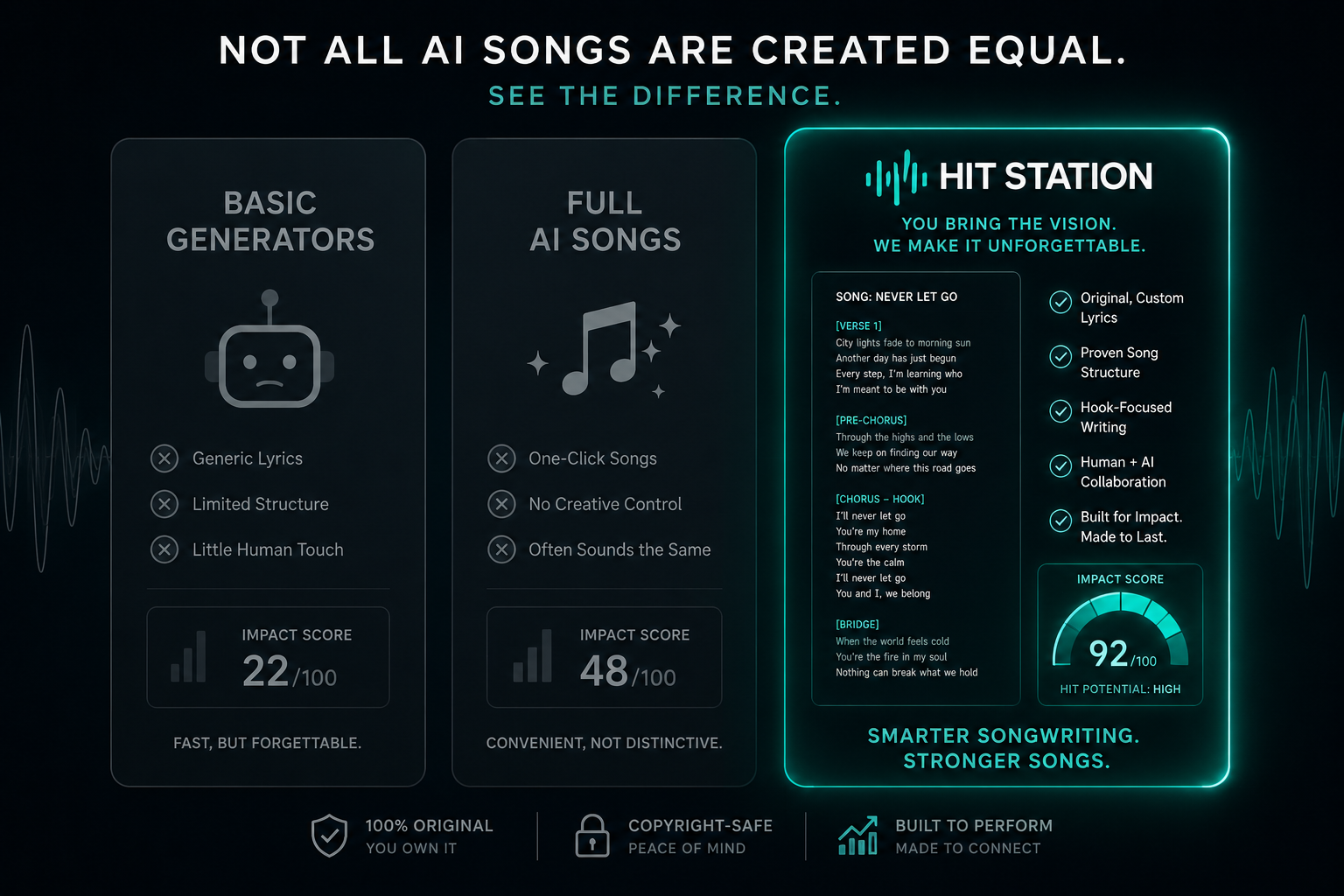
AI lyric generators are everywhere now. Type a theme into a website and it produces a verse and chorus in seconds. For a quick spark, that can be useful—but most of these tools stop at “first draft” and leave you on your own when it is time to actually make the song good.
Hit Station was built for the opposite use case. It is not just an idea toy or a black-box song generator; it is a full lyric-writing environment that combines a proven hit-writing methodology, a scoring system, and professional editing tools. Instead of replacing writers, it is designed to make them measurably better with every session.
The problem with most AI lyric generators
Most AI lyric platforms fall into one of two buckets.
- Basic lyric generators take a topic or mood and return verses and choruses with minimal control over structure, hook behavior, or emotional depth. There is rarely any feedback beyond “copy or regenerate,” and the tools do not teach you why one output is better than another.
- Full AI song generators go even further, creating complete tracks from a single prompt—but they hide the process, make it hard to control lyrics, and often raise ownership and copyright questions.
Reviews and creator discussions regularly point out the same limitations: outputs feel generic, narratives drift, chorus lines lean on clichés, and users still have to rewrite 50–80% of the lyric to make it release-ready. In other words, many tools help with speed, but not with craft.
Hit Station’s core advantage: The Hit Maker framework
Hit Station starts where generic generators stop. It is built around The Hit Maker methodology—a structured framework that shapes every line by genre-specific structure, hook strategy, emotional drivers, and platform constraints.
Instead of throwing random sections at you, Hit Station:
- Forces the key decisions first: genre and sub-genre, emotional core, hook type, target structure, BPM, and vocal identity.
- Builds lyrics on the same structural principles as modern hits: chorus carries the hook, pre-chorus escalates tension, bridge earns the final payoff.
- Offers four format templates (Viral Hook, Radio Single, Streaming, Full Arrangement) with word budgets per section so each line has to earn its place.
Where other tools assume structure, Hit Station designs it—so the lyrics it generates are already aligned with real-world song forms rather than vague “verse/chorus” placeholders.
Objective feedback vs “guess and hope”
Most lyric generators treat every output as equally valid. If you do not like it, you regenerate; if you like parts of it, you copy and paste. There is no way to know whether the new version is actually better or just different.
Hit Station solves this with the Hit Score, a deterministic scoring model that evaluates each song across five weighted dimensions:
- Hook Strength (30%)
- Emotional Resonance (25%)
- Structural Efficiency (22%)
- Platform Compatibility (18%)
- Cultural Timing (5%)
Each score comes with specific, prioritized recommendations—for example, “your chorus does not repeat the hook phrase enough” or “Verse 2 drifts from the emotional driver.” Instead of guessing what feels off, you see exactly which dimension is weak and how to fix it. No mainstream lyric generator offers this level of structured feedback.
Alt Takes and version history vs copy/paste roulette
In many AI lyric tools, experimentation means copying results into a document or starting a new tab, hoping you do not lose the line you liked. There is no concept of systematic A/B testing for different choruses or verses.
Hit Station builds experimentation into the core workflow:
- Alt Takes let you create multiple versions of any section—chorus, verse, pre-chorus, bridge—compare their scores side by side, and apply the winner.[^2]
- The original is always saved and clearly badged, so you can take big swings without fear of losing a good draft.[^2]
- Version history stores unlimited drafts with score snapshots, so you can see how the song improved over time and roll back in one click.[^2]
This turns rewriting into a measurable process, not a messy clipboard exercise. It also trains your ear: you start to hear how changes in hook repetition, specificity, or line length affect the score.
Multilingual, genre-true writing vs one-size-fits-all text
Most lyric generators write primarily in English and treat other languages as translations at best. Even when they support multiple languages, they often miss rhyme, cadence, and cultural nuance, because they are not actually optimizing the lyric inside that language’s musical context.
Hit Station supports eight languages—English, Spanish, French, German, Portuguese, Japanese, Korean, and Mandarin—with the full methodology applied natively. Hooks, rhyme, and cadence are engineered in the target language from the start, and genres include Latin, Caribbean, Neo-Soul, and more with tuned vocabulary and phrasing. That means your Spanish ballad or Korean pop song is not just translated English; it is built to sound like it belongs on a real playlist.
Lyrics-first design vs one-click audio
Many AI music platforms treat lyrics as an afterthought to audio. They may offer a lyric field, but there is little support for detailed editing, section-by-section regeneration, or collaboration. As a result, writers either accept what the system gives them or leave to another tool to fix the words.
Hit Station goes the other way: it intentionally does not generate audio. It is lyrics-first and lyrics-only, focusing on the part of the process where words, structure, and narrative are shaped. Instead of competing with text-to-music engines, it feeds them:
- Suno-ready exports with section markers, tempo notation, dynamics cues, vocal style tags, and sub-genre hints.
- Instrumentation and vocal recommendations so producers can quickly understand the intended sonic context of the lyric.
This separation of concerns—Hit Station for lyrics, other tools for audio—gives writers and producers deeper control over each layer without sacrificing speed.
Learning value vs disposable drafts
Reviewers and educators consistently note that generic lyric generators offer little educational value; users may get ideas, but they do not become better writers by using them. The tool does not explain why certain lines work or how to systematically improve.
Hit Station is explicitly designed as a learning environment:
- Guided new-song wizard forces you to define genre voice, emotional core, and subject before writing, reinforcing professional habits.
- Real Writing Progress stages (“Drafting chorus hook,” “Arranging verses,” “Scoring sections”) reveal the process behind the output.
- Improvement missions and analytics help writers track score trends across their catalog, making growth visible over time.
In short, other tools give you lyrics; Hit Station helps you become a lyricist.
Comparison: generic lyric generators vs Hit Station
Here is a simplified view of how Hit Station stacks up against typical AI lyric tools.
| Feature | Generic lyric generators | Full AI song generators | Hit Station |
|---|---|---|---|
| Primary output | Plain text lyrics | Finished audio with lyrics | Scored, protected, export-ready lyrics |
| Creative control | Prompt lottery | Minimal, black-box decisions | You direct every choice via Hit Maker framework |
| Methodology | None | Hidden | Explicit hook and structure methodology |
| Feedback | Regenerate or copy/paste | None | 5-dimension Hit Score with targeted recommendations |
| Experimentation | Manual copy of versions | Limited | Alt Takes + version history, original always saved |
| Language support | Mostly English, basic others | Varies | Eight languages with native hooks and rhymes |
| Audio integration | Little or none | Integrated but opaque lyrics | Suno-ready export, clear handoff to any text-to-music engine |
| Learning value | Low | Minimal | Missions, analytics, process visibility |
| Rights & documentation | Rarely addressed | Often unclear | Timestamped PDFs, IP protection, collaboration records |
This is why Hit Station positions itself as a lyric-writing platform, not just a lyric generator. It gives creators the tools they need to turn AI assistance into lasting catalog assets instead of disposable experiments.
Who benefits most from Hit Station’s advantages
Hit Station’s superiority shows up most clearly for:
- Emerging songwriters who want to learn real craft instead of memorizing prompt tricks.
- Professional lyricists who need speed but cannot compromise on control or quality.
- Producers and independent artists building streaming-optimized catalogs that must hit structural and platform constraints.
- Writing teams and catalogs that care about governance, consistency, and rights.
If the goal is to publish songs that listeners remember—and that can actually be licensed and protected—Hit Station is not just another option. It is the only AI lyric platform that treats hit-writing as a repeatable, measurable discipline.